North Terrace Campus The University of Adelaide Australia
North Tce Campus
The Waite Campus
Roseworthy Campus
Thebarton Campus
Campuses Home
North Terrace Campus
Campus Setting
Campus Life
City of Adelaide

text zoom: S | M | L

Contact Details:

THE UNIVERSITY OF ADELAIDE
SA 5005 AUSTRALIA

Phone: +61 8 8303 5208
(Country and interstate callers toll free on 1800 061 459)
Fax: +61 8 8303 4401


You are here: Campuses & Maps > North Terrace Campus

Print View

North Terrace

For 134 years the University of Adelaide has been at the heart of South Australian life, shaping education, research, culture, politics and economics. We have equipped our graduate students to become leaders in their chosen field by providing an environment where they are encouraged to develop independence of thought, creativity and confidence.

The University of Adelaide is the oldest university in South Australia, and the third oldest nationally. Its first campus on North Terrace has a long tradition of excellence that built the University's reputation as one of Australia's premier research and academic institutions. Adelaide is consistently listed among the world's top universities, currently ranked number 62 in the UK's THES-QS World University Rankings.

The University's three-year building development program - Our Space Your Space provides information on building projects taking place, including all lift upgrades on the North Terrace Campus.

'Explore the past - discover the future' on our Campus Tours.

Unique History

North Terrace is the earliest permanent home of the University. Development of the campus began when the South Australian Parliament granted five acres (2 hectares) to the University of Adelaide established in 1874.

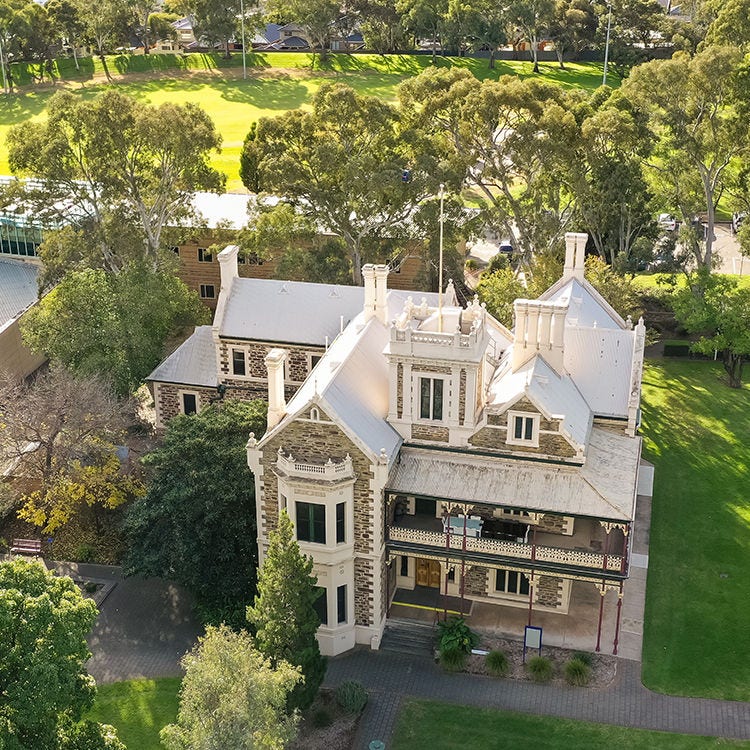
The Mitchell Building accommodated the entire University when it opened in 1882, although the University's academic life had begun in a city building six years earlier. The heritage-listed building features the restored foyer with its ornate pillars, elegant staircase, stained glass windows and vaulted cedar ceilings. Fine stonework is a feature of the Mitchell Building, a landmark building on Adelaide's North Terrace boulevard. The building is named after the philosopher Sir William Mitchell, who was Vice-Chancellor from 1916 to 1942, and Chancellor from 1942 to 1948. A statue of Sir Walter Watson Hughes, who with Sir Thomas Elder provided funds to establish the University, is located at the front of the building.

Elder Hall, opened in 1900 by Lord Tennyson (who was Governor of South Australia), houses the Elder Conservatorium of Music and is a popular venue for concerts and public lectures. A statue of Sir Thomas Elder is outside Elder Hall. Elder Hall lunchtimes are a concert series held every Friday during semester and at other times.

Bonython Hall, completed in 1936, seats 1000 and is used for University graduation ceremonies, conventions and major public events. The hall is named after Sir John Langdon Bonython, chairman of Roseworthy Agricultural College from 1895 to 1902 and a member of the University of Adelaide Council from 1916 to 1939. He made many important public benefactions, notably to endow a chair of law at the University of Adelaide in 1926, and towards Bonython Hall from 1930 to 1934.

Outside the North Terrace gates stands a statue of Antarctic explorer Sir Douglas Mawson, who was appointed Professor of Geology and Mineralogy in 1921. The Tate Museum is open to the public (Mawson Laboratories, open 9:00am-5:00pm Monday to Friday). Artefacts from Sir Douglas Mawson's expeditions are among the items displayed.

The Barr Smith Library is named in honour of the Barr Smith family, which was prominent in South Australian business and pastoralist activity over many years, and made many gifts and bequests to the University of Adelaide. The original building of the library, opened in 1932, is now the Barr Smith Reading Room with heritage status. The Barr Smith Library occupies a central position on campus and is the largest branch of the University of Adelaide Library, which also includes the Law Library (Sir John Salmond Library), Elder Music Library, Waite Library and Roseworthy Campus Library. The University Library holds more than two million books and journals (in excess of 45,000 titles), forming one of the largest and best-known research collections in Australia.

Union Hall, built in the 1950s, and the Scott Theatre are major public theatre venues. The Schulz Building is the tallest building on the western side of the campus close to Kintore Avenue.

Union House and the University Cloisters, a World War I Memorial, provide an important centre for student activities. Union House is the home of many student services including a Computer Resource Centre, Wills Student Lounge and the Sports Hub Fitness Centre. Union House also contains a number of food and beverage outlets including Mayo Café, Union Bookshop Café, the UniBar and Rumours Café - a licensed café offering excellent views over the parklands. Members of the public are welcome at these outlets. Union House offers various meeting and function rooms available for hire to the University and general public. These include the Little Theatre and the Equinox Function Room.

Art and architecture are interesting features of North Terrace. A Henry Moore bronze sculpture, Reclining Connected Forms, located in the Walter Young Garden near the Napier Building, is one of eight significant sculptures on campus.