
Latest news
Search news stories
Enter a keyword to search news.
One Hundred Factorial - the puzzle and the event
The weekly puzzle session that I run at the University of Adelaide is called One Hundred Factorial. In the middle of the night, I suddenly realised that I have never written about why it is called One Hundred Factorial, and so here is the story.
[Read more about One Hundred Factorial - the puzzle and the event]
The Operation Tower
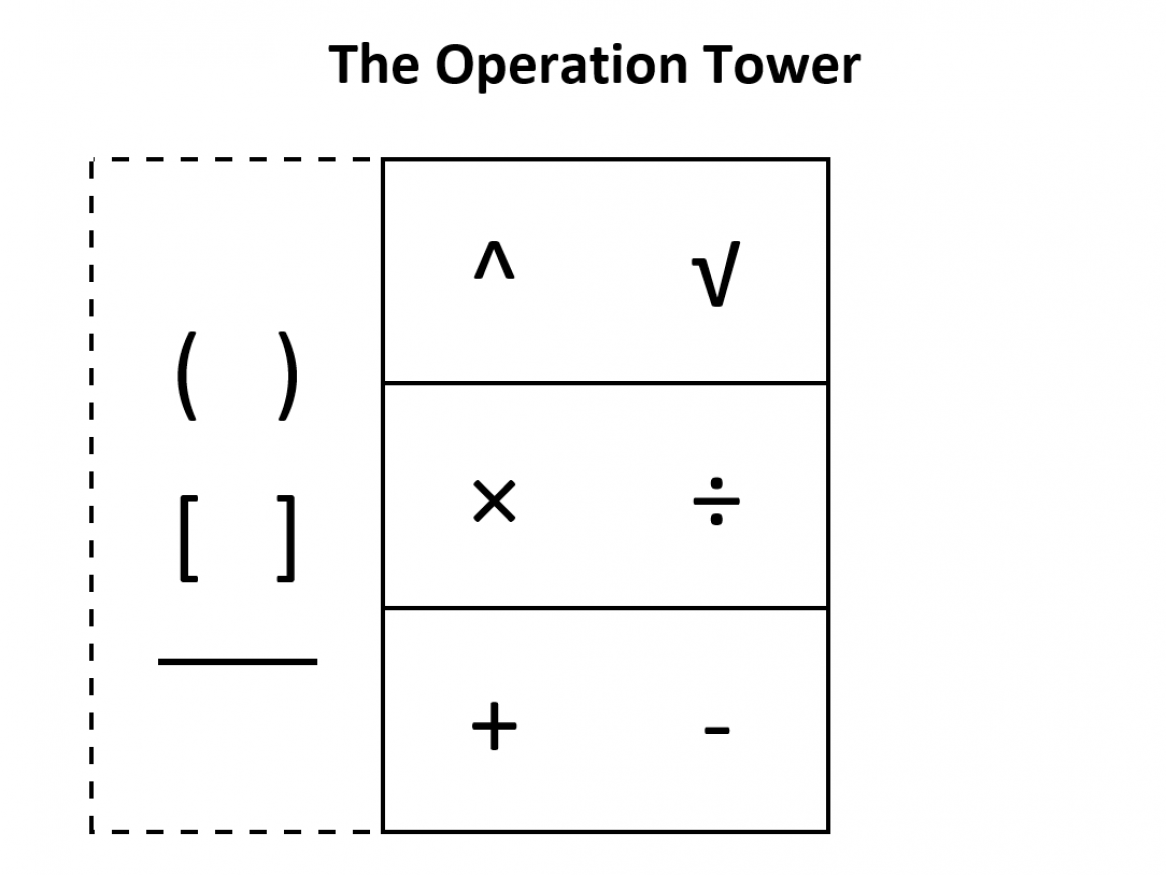
I don't like BODMAS/BEDMAS/PEMDAS/GEMS/GEMA and all of the variations on this theme. I much prefer to use something else, which I have this week decided to call "The Operation Tower".
Digit Disguises
This blog post is about a game I invented this week, and the game is AWESOME, if I do say myself.
Context fatigue
Context fatigue is a particular kind of mental exhaustion that happens after having to make sense of multiple different contexts that maths/statistics is embedded in. I feel it regularly, but I feel it most strongly when I have spent a day helping medical students critically analyse the statistics presented in published journal articles.
The curse of listening
I am often saying how important it is to listen to students, and that I am fascinated by student thoughts and feelings. When students say I am a good teacher my usual response is to say it’s because I have spent the last eleven years in a situation where I get to listen to lots of students.
The importance of names
Three years ago, my university's Student Engagement Community of Practice collectively wrote a series of blog posts about various aspects of student engagement. I thought I would reproduce my blog post here, since it is still as relevant today as then.
Struggling students are exploring too
I firmly believe that all students deserve to play with mathematical ideas, and that extension is not just for the fast or "gifted" students. I also believe that you don't necessarily need specially designed extension activities to do exploration – a simple "what if" question can easily launch a standard textbook exercise into an exploration.
Trying maths live on Twitter
Once upon a time, I decided I would be vulnerable on Twitter. As part of that, when someone posted a puzzle that I was interested in, I decided that I would not wait until I had a complete answer to a problem before I responded, but instead I would tweet out my partial thinking. If there were mistakes I would leave them there and respond with how I resolved them, rather than deleting them and removing the evidence that I had made a mistake. I wanted the whole process of solving problems to be out there in plain sight for everyone to see.
Tutorials for an intro Arts course: Story makes sense of number
Sometime in the past, I was approached by academics in the Faculty of Arts to discuss the numeracy skills of the students in their faculty. They wanted to discuss how they might include numeracy skills in some of their courses across all the degrees they teach. It was a lot bigger than the MLC could reasonably do, but I said I would certainly be able to do a small thing in a few courses, and certainly help their students in the MLC itself when they came to talk.
[Read more about Tutorials for an intro Arts course: Story makes sense of number]
Playing SET
Amie Albrecht recently posted a most wonderful blog post about SET, and it reminded me there were some SET-related things I should post too.